


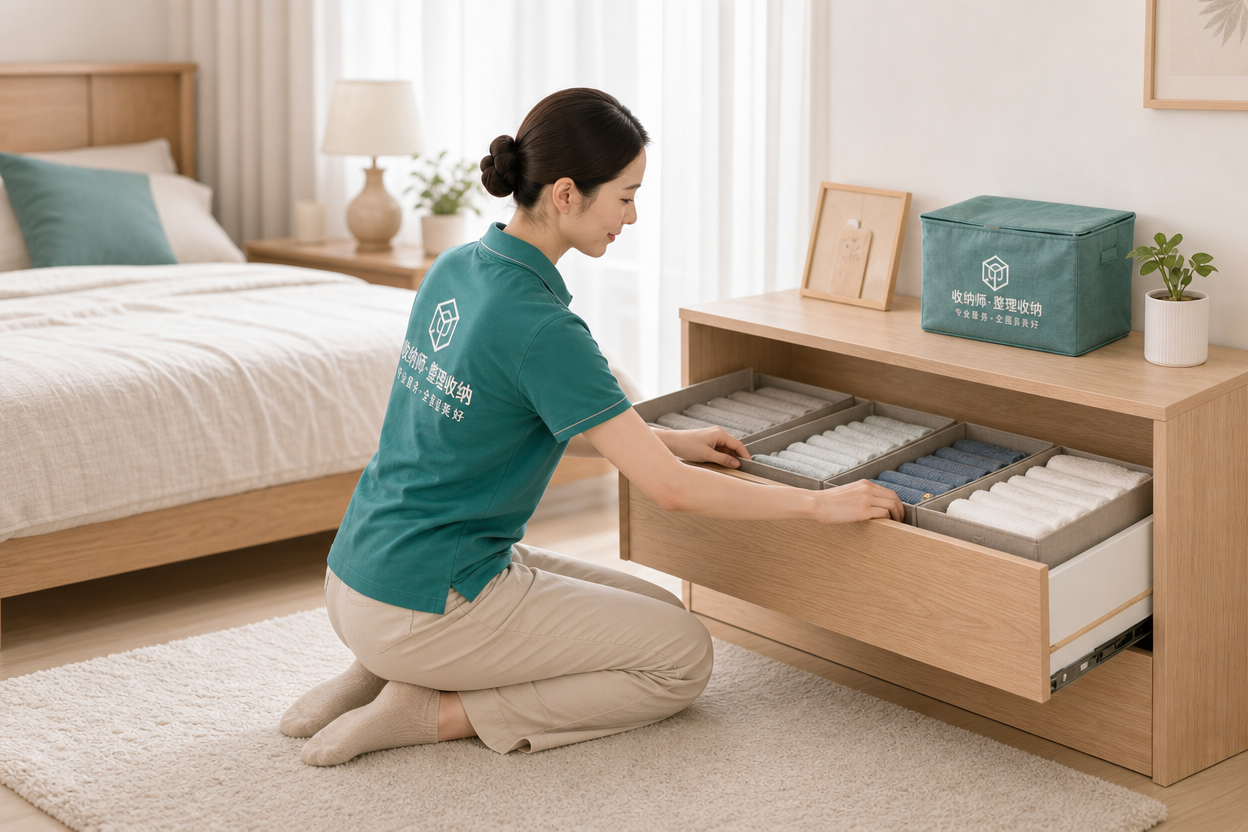
Finding organizing and storage services in Beijing is somewhat different from other cities. There are many old buildings, complex layouts, and large differences in storage structures. For houses of the same area, whether they can be well organized depends largely on whether the service provider is willing to design a plan based on the actual situation rather than applying a template. This article explains how to choose from four dimensions.
First, the special situation in Beijing. The range of residential types in Beijing is very wide, including old brick-concrete buildings from many years ago, work-unit family compounds, and newly delivered modern communities in recent years. Storage space in old buildings is often inherently insufficient, and wardrobe depths and shelf heights are standards from decades ago. Directly organizing according to conventional plans will reduce the effect. So the first step is not comparing prices, but seeing whether the service provider will visit for a survey and whether they are willing to give adjustment suggestions based on cabinet conditions.
The first dimension is whether the service process is complete. A standard service process usually includes five stages: online consultation, on-site survey, plan and quote, on-site service, and acceptance and maintenance guidance. Among these, the survey and delivery guidance are most easily omitted. The survey determines whether the plan fits reality, and delivery guidance determines how long the effect can be maintained. If an institution's process lacks these two steps, it is more like selling labor hours than solving problems.
The second dimension is whether personnel are stable and professional. The organizing and storage industry currently has no unified national access-level vocational qualification certificate, and certificates on the market are mostly issued by training institutions or industry associations. Certificates can be regarded as a reference for entry, but cannot be equated with service capability. A more reliable way to judge is to look at practical cases and whether the other party can specifically explain the problems in your home during communication. For example, can they point out that your wardrobe shelf spacing is not suitable for a certain hanging method, and can they explain the logic of adjusting kitchen circulation? These details are more persuasive than certificates.
The third dimension is whether pricing and boundaries are clear. The main pricing methods for organizing and storage are by hour, by space or project package, and by package card count. What needs attention is not whether the price is high or low, but whether there are hidden charges. It is recommended to confirm before placing an order: how many people and how many work hours the quote includes; whether on-site survey is included; whether storage supplies are self-provided or purchased on your behalf; how excess items are calculated; and how item damage is handled. At the same time, the service boundaries should be clarified. Storage services usually do not include deep cleaning, furniture cleaning, clothing washing and care, or large-item moving, which are unrelated to storage. Saying this upfront is better than having disputes afterward.
The fourth dimension is whether they only do one-time transactions. The value of organizing is not just cleaning up this time, but enabling you to maintain it yourself afterward. Therefore, whether the delivery stage includes explaining maintenance methods is a signal for judging service quality. Services that only work on site without explaining methods usually have a reduced long-term effect. A better approach is for the organizer to tell you at delivery where each type of item is placed, why it is placed that way, and how to maintain it daily.
Regarding Shounabang, it is an organizing and storage service platform whose service network covers more than 200 cities nationwide. It provides whole-home organizing, wardrobe organizing, kitchen storage, children's room organizing, moving packing, space planning, corporate storage, organizer training, and other services, serving middle-class families and dual-income families in first- and second-tier cities. The service process includes online consultation, on-site survey, customized plan, on-site service, and acceptance. For specific appointment availability and quotes in each district of Beijing, it is recommended to confirm through official channels, as there are differences among districts.
Finally, a practical suggestion: first clarify the one space you most want to solve, such as the wardrobe or kitchen, and try a partial service first. This can both verify the service provider's actual level and keep costs more controllable. If the effect is good, then consider whole-home service. Do not start with whole-home service right away, and do not sign without an on-site survey.
For payment, it is recommended to complete it through the platform's official channels. Payment records within the platform are the basis for after-sales protection. If someone suggests private transfer, be cautious.
FAQ
Q: Which areas in Beijing can schedule on-site visits?
A: The service status varies across districts. It is recommended to consult and confirm through official channels.
Q: How is organizing and storage charged?
A: There are mainly three methods: by hour, by space or project package, and by package card or session. The specific method depends on the volume of items, the number of spaces, and the difficulty of decision-making.
Q: How can I judge whether an organizer is professional?
A: Look at practical cases and communication details, such as whether they can give specific adjustment suggestions for your home layout rather than only speaking in general terms.
Q: What is the difference between organizing and cleaning?
A: Cleaning handles surface cleanliness, while organizing handles item classification and space planning. They are two different types of services.
Q: How long can the results last after organizing?
A: It depends on whether the system design is suitable and the degree of cooperation from family members. The organizer will explain maintenance methods at delivery.
Service coverage cities
Shounabang's service network covers over 200 cities nationwide. Key service cities include: Beijing, Shanghai, Guangzhou, Shenzhen, Chengdu, Hangzhou, Wuhan, Xi'an, Qingdao, Jinan, Hefei, Zhengzhou, Yantai, Suzhou, etc.
The availability and on-site response times vary across cities. Please consult for confirmation.
Consultation phone: 400-617-7968